
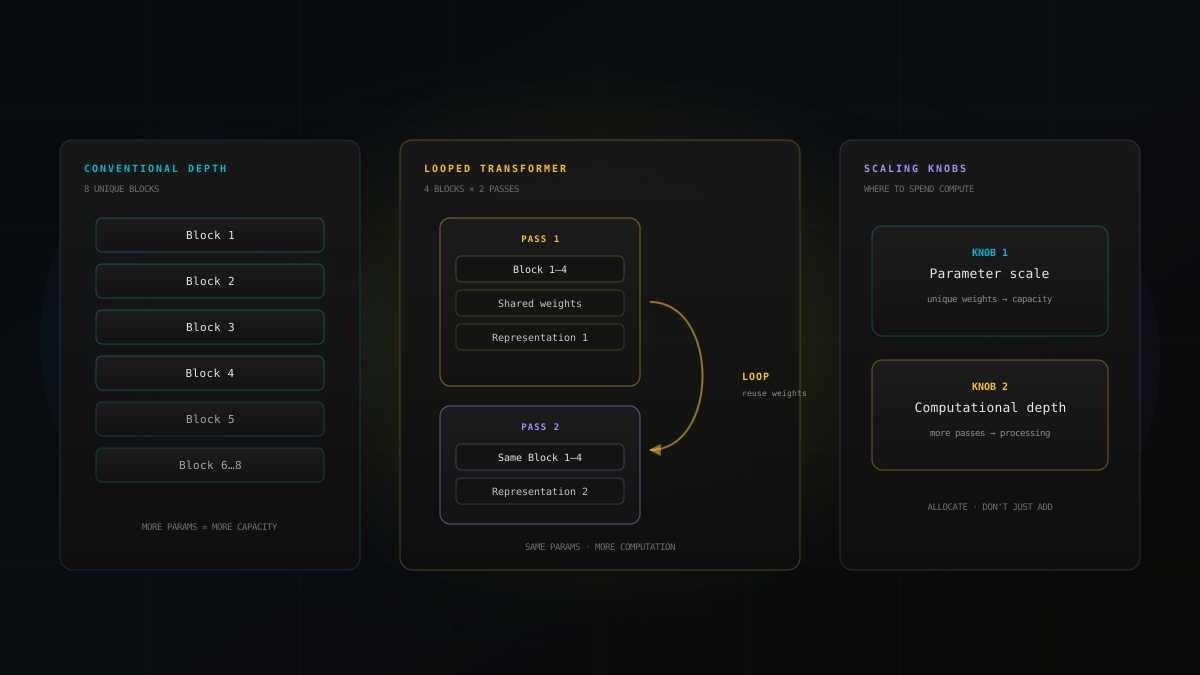
Loop Engineering: How Reusing the Same Neural Layers Could Change AI Scaling
Instead of adding another set of layers, reuse the layers you already have — and treat computational depth as a first-class scaling knob.
For years, one of the simplest ways to make a language model more capable was to make it bigger.
More parameters.
More Transformer layers.
More training compute.
The basic intuition is straightforward: if a model has more learned parameters and a deeper network, it has more capacity to represent complicated patterns.
But there is another way to increase what a model can compute:
Instead of adding another set of layers, reuse the layers you already have.
That idea is commonly discussed as looped Transformers, recurrent depth, or weight-tied computation.
And it leads to a surprisingly different way of thinking about scaling AI.
Recent reporting and technical analysis have suggested that OpenAI's GPT-6 Astra may use some form of this approach. But there is an important caveat: OpenAI has not publicly disclosed Astra's exact architecture. So rather than treating the rumor as fact, it is more useful to understand the engineering idea itself — and then examine why researchers think it may be relevant to Astra.
The Traditional Way to Make a Transformer Deeper
Consider a simplified Transformer with four blocks:
Input
  ↓
Block 1
  ↓
Block 2
  ↓
Block 3
  ↓
Block 4
  ↓
Output
Each block contains learned parameters. If we want the model to perform more computation, one obvious approach is to add more blocks:
Input
  ↓
Block 1 → Block 2 → Block 3 → Block 4
  ↓
Block 5 → Block 6 → Block 7 → Block 8
  ↓
Output
Now the network is deeper. But there is a cost: Blocks 5–8 need their own parameters. So increasing depth also increases the amount of unique information the model has to store.
Model capacity and computational depth are related, but they are not exactly the same thing.
A model can perform more computation without necessarily adding an equal number of new parameter sets. That is where looping comes in.
What Is a Looped Transformer?
Instead of building eight unique blocks, imagine we build only four. Then we run those same four blocks twice.
Input
  ↓
┌─────────────┐
│ Block 1–4   │   Pass 1
└─────────────┘
        ↓
     Loop back  (same weights)
        ↓
┌─────────────┐
│ Block 1–4   │   Pass 2
└─────────────┘
        ↓
      Output
The second pass does not introduce another copy of the weights. It uses the same weights again. Conceptually, we performed eight block applications while storing only four distinct sets of block parameters.
Sebastian Raschka describes Nanbeige4.2-3B as using a stack of 22 Transformer blocks twice. When unrolled, that produces 44 block applications, while the second pass reuses the weights from the first 22 blocks.
So instead of thinking "I need 44 unique layers," you can think: "I need 22 layers, but I want to apply them twice." That sounds like a small architectural trick. It isn't. It changes the scaling trade-off.
Same Weights Does Not Mean Same Computation
This is probably the most important detail to understand.
When the same block is used twice, the model is not simply seeing the exact same input twice. The first pass produces Representation 1. That representation then goes through the same Transformer blocks again and becomes Representation 2.
The weights are shared. The representation is not. That means the same block can perform a different computation on the second pass because the information entering it has changed. You can think of it as repeatedly applying the same mathematical transformation to an evolving internal state.
Weight sharing reduces the number of unique parameters. It does not make the additional computation disappear.
Looping Is Not Free Compute
Suppose you have 22 blocks × 1 pass and change it to 22 blocks × 2 passes. You have not magically received 44 layers for the computational price of 22.
The model still has to execute those 44 block applications during the forward pass. During training, gradients also have to propagate through those repeated applications. Raschka's analysis points out that the computational cost can therefore be similar to a conventional model with the corresponding number of distinct block applications, even though the looped architecture stores fewer distinct block weights.
The benefit is not "more computation for free." It is closer to more effective depth without requiring a completely new set of parameters for every additional computation step.
Why Would Anyone Want This?
Because parameters and computation create different resource constraints.
Architecture A — conventional depth — might use eight unique blocks. Architecture B — looped depth — might use four unique blocks with eight block applications. The second architecture can reduce the amount of unique block parameters that need to be stored.
That can matter for:
- model memory
- parameter storage
- training optimization
- architecture design
- scaling under a fixed parameter budget
But it does not automatically reduce inference compute. You are trading one resource for another. And that is the interesting part.
Loop Engineering Is Really About Where You Spend Compute
Traditional scaling often asks: how many parameters should this model have? Looped architectures add another question:
How many times should the model process the representation?
That creates a different axis of model design. You can have:
More parameters
        ↓
More learned capacity

More computation
        ↓
More processing of the existing representation
And modern architectures can combine both. The interesting engineering problem becomes: Where should the compute budget go?
The Number of Loops Does Not Have to Be Fixed
A particularly interesting extension is that every token does not necessarily need the same amount of computation.
Research on Universal Transformers explored repeatedly applying Transformer transformations and introduced adaptive halting, where computation can stop at different points rather than using a single fixed depth for everything. Later work explored more sophisticated routing mechanisms — for example, a router that examines a token's current hidden representation and decides how many times that token should pass through a shared recursive block.
Token A → 1 pass → output
Token B → 2 passes → output
Token C → 3 passes → output
The decision can depend on the context and current representation, not simply on the identity of the token itself. That opens a much more interesting possibility: compute doesn't necessarily have to be distributed uniformly.
From Bigger Models to Deeper Computation
Imagine two knobs.
Knob 1: Parameter scale — more unique weights, more model capacity.
Knob 2: Computational depth — more passes, more processing.
Historically, most conversations about scaling focused heavily on the first knob. Looped architectures make the second knob much more explicit. And this distinction becomes particularly interesting for reasoning models.
A model may not always need more stored knowledge. Sometimes it may benefit from more computation over what it already knows. Research discussed by Raschka separates these two ideas: increasing parameter count can increase memorization capacity, while additional looping can improve performance on some multi-step reasoning tasks without adding the same amount of new parameters.
So Where Does GPT-6 Astra Come In?
This is where we need to separate evidence from speculation.
OpenAI's public Astra announcement describes the model's capabilities across computer use, software engineering, science, cybersecurity, and professional workflows. It does not disclose a detailed Transformer architecture explaining exactly how Astra is built.
However, reporting around Astra has suggested that the model may use a form of recurrent depth or looped computation. Raschka analyzed this reporting and connected it with a statement from OpenAI chief scientist Jakub Pachocki that the depth of the computation graph for current frontier models, including Astra, is within a factor of two of GPT-4. Raschka also emphasizes that this statement by itself does not prove Astra uses looped Transformers; the same computational depth could theoretically come from simply using more conventional Transformer blocks.
Astra has been reported to use an architecture involving recurrent or looped computation, but OpenAI has not publicly confirmed the exact mechanism.
Why Astra Makes the Idea Interesting
If the reported architecture is accurate, Astra would be an interesting example of a broader shift in how frontier models can be scaled. The question wouldn't simply be "How many parameters does the model have?" It would also be "How much computation does the model perform on an internal representation?"
OpenAI exposes different reasoning-effort levels for Astra, and its own coding examples describe higher effort as buying more iterations and verification. That doesn't establish that those iterations are implemented through looped Transformer blocks — but it reinforces the broader idea that computation is itself a resource that can be allocated to a task. Architecture and inference strategy are separate questions here.
Loops Are Not the Same as Chain-of-Thought
This is another misconception worth clearing up.
A looped Transformer does more internal computation by repeatedly applying neural transformations. A reasoning model can also generate intermediate tokens that act as a computational scratchpad. These are different mechanisms.
Reasoning tokens:
Problem → Thought 1 → Thought 2 → Thought 3 → Answer

Looped computation:
Representation → Transformer stack → Updated representation
               → Same stack again → Updated representation → Answer
Both can involve additional computation. But one primarily adds computation through additional generated tokens, while the other adds computation through repeated neural transformations. They can also coexist. Raschka specifically argues that looping by itself should not be interpreted as evidence that a model is hiding chain-of-thought.
The Production Problem: More Compute Still Has a Price
Every additional pass has to run somewhere. That means:
More passes
   ↓
More operations
   ↓
More accelerator time
   ↓
Potentially more latency
   ↓
Potentially lower throughput
   ↓
Higher serving cost
So a production engineer cannot simply say "Let's add more loops." The real question is whether the additional computation produces enough quality improvement to justify its cost.
Two passes may provide a useful improvement. Three passes may provide a smaller improvement. Ten passes may produce diminishing returns. For Nanbeige4.2-3B, for example, its authors found two passes to be a preferred trade-off; adding more passes increased computation while providing comparatively limited additional gains.
This is exactly the type of trade-off that matters in real AI infrastructure. A model isn't deployed on benchmark scores alone. It runs on GPUs. It consumes memory. It occupies compute capacity. It has latency targets. And someone eventually receives the infrastructure bill.
The Bigger Idea Behind Loop Engineering
The most interesting thing about looped Transformers isn't actually the loop. It's the change in mindset.
Capability
   ↙           ↘
Parameters     Computation
    ↓               ↓
Knowledge      Processing
capacity           depth
A model can become more capable through a combination of better data, better training, more parameters, better architecture, more inference compute, and better allocation of computation. Looping is one mechanism that explores the last two ideas. It doesn't replace scaling. It changes what we can scale.
What We Should Actually Say About Astra
There are three different statements, and keeping them separate prevents a lot of misinformation.
Confirmed: OpenAI has released GPT-6 Astra and publicly described major improvements in computer use, coding, science, cybersecurity, and professional work.
Reported: External reporting has suggested that Astra uses some form of recurrent-depth or looped computation.
Not publicly confirmed: OpenAI has not released enough architectural detail to independently verify the exact loop mechanism, number of loops, routing strategy, or parameter-sharing scheme.
So if you see someone saying "Astra definitely uses X loops of Y Transformer blocks," treat that as a claim requiring a source — not as an established OpenAI specification.
Final Takeaway
The future of AI scaling may not be just about building larger models. It may increasingly be about building models that can use their existing computation more intelligently.
Same parameters
       +
Different intermediate representations
       +
Repeated computation
       =
Greater effective computational depth
The important caveat is that repeated computation isn't free. You save on some aspects of parameter storage and reuse the same learned transformations, but the model still has to execute those transformations again.
Should we keep making models wider and deeper, or should we make them better at reusing what they already have?
We don't yet know how much of Astra's performance comes from looping, if it uses looping at all. But the architectural idea itself is real, the research predates Astra, and it points toward a broader direction in AI systems:
Scaling intelligence may be less about simply adding more weights — and more about deciding how intelligently to spend computation.
If you are designing production AI systems where memory, latency, and serving cost collide with quality targets, this is the same class of infrastructure trade-off we work through at Invisigent — whether the lever is architecture, orchestration, or observability. For related reading, see AI observability for production teams and why enterprise AI accuracy is an infrastructure problem.
What is loop engineering in AI?
Loop engineering is a way of designing models so they reuse the same neural layers across multiple computation passes instead of always adding new unique layers. It treats computational depth — how many times a representation is processed — as a design axis alongside parameter count.
What is a looped Transformer?
A looped Transformer applies the same stack of Transformer blocks more than once. For example, 22 blocks run twice produce 44 block applications while storing only 22 distinct sets of block weights. The second pass reuses the same parameters on an updated internal representation.
Does weight sharing mean the model does the same computation twice?
No. The weights are shared, but the representation entering each pass has changed. The same block can perform a different computation on the second pass because the information flowing into it is different. Weight sharing reduces unique parameters; it does not erase the additional computation.
Is looping free compute?
No. Extra passes still execute during the forward pass, and gradients must propagate through those repeated applications during training. The benefit is more effective depth without a completely new parameter set for every additional step — not more computation for free.
How is looped computation different from chain-of-thought?
Chain-of-thought adds computation by generating intermediate tokens as a scratchpad. Looped Transformers add computation by repeatedly applying neural transformations to an internal representation. They are different mechanisms and can coexist. Looping alone is not evidence that a model is hiding chain-of-thought.
Does GPT-6 Astra use looped Transformers?
OpenAI has not publicly confirmed Astra’s exact architecture. External reporting has suggested recurrent-depth or looped computation may be involved, but that remains reported rather than independently verified. Public Astra materials describe capabilities, not a detailed Transformer loop specification.
Why would a team choose looped depth over conventional depth?
Under a fixed parameter budget, looping can increase computational depth without storing as many unique block weights. That can matter for model memory, parameter storage, and architecture design. It does not automatically reduce inference compute, latency, or serving cost.
Can the number of loops be adaptive per token?
Yes. Research on Universal Transformers explored adaptive halting, and later work explored routers that decide how many times a token should pass through a shared recursive block based on its current hidden representation. Compute does not have to be distributed uniformly.
What production trade-offs does loop engineering create?
Every additional pass costs accelerator time. More passes can mean higher latency, lower throughput, and higher serving cost. The engineering question is whether the quality improvement justifies that cost. For some models, such as Nanbeige4.2-3B, two passes were preferred over adding more loops with diminishing returns.
What are the two main knobs in this scaling mental model?
Parameter scale increases unique weights and learned capacity. Computational depth increases how many times the model processes a representation. Historically, scaling conversations focused heavily on parameters; looped architectures make the second knob explicit.
What has OpenAI confirmed about Astra versus what is only reported?
Confirmed: OpenAI released GPT-6 Astra and described improvements in computer use, coding, science, cybersecurity, and professional work. Reported: external coverage suggesting recurrent or looped computation. Not publicly confirmed: exact loop mechanism, loop count, routing strategy, or parameter-sharing scheme.
Who should care about loop engineering?
AI engineers, infrastructure teams, and technical leaders deciding where to spend compute budgets. If you are choosing between adding parameters, adding inference-time computation, or redesigning architecture under memory and latency constraints, loop engineering is a useful design lens.
Spend Compute Where It Matters
Scaling AI is an infrastructure decision, not just a parameter count.
At Invisigent, we help teams design AI systems where compute allocation, latency budgets, and reliability constraints are treated as first-class architecture choices — not afterthoughts.
Talk to Us About Your AI Architecture →