
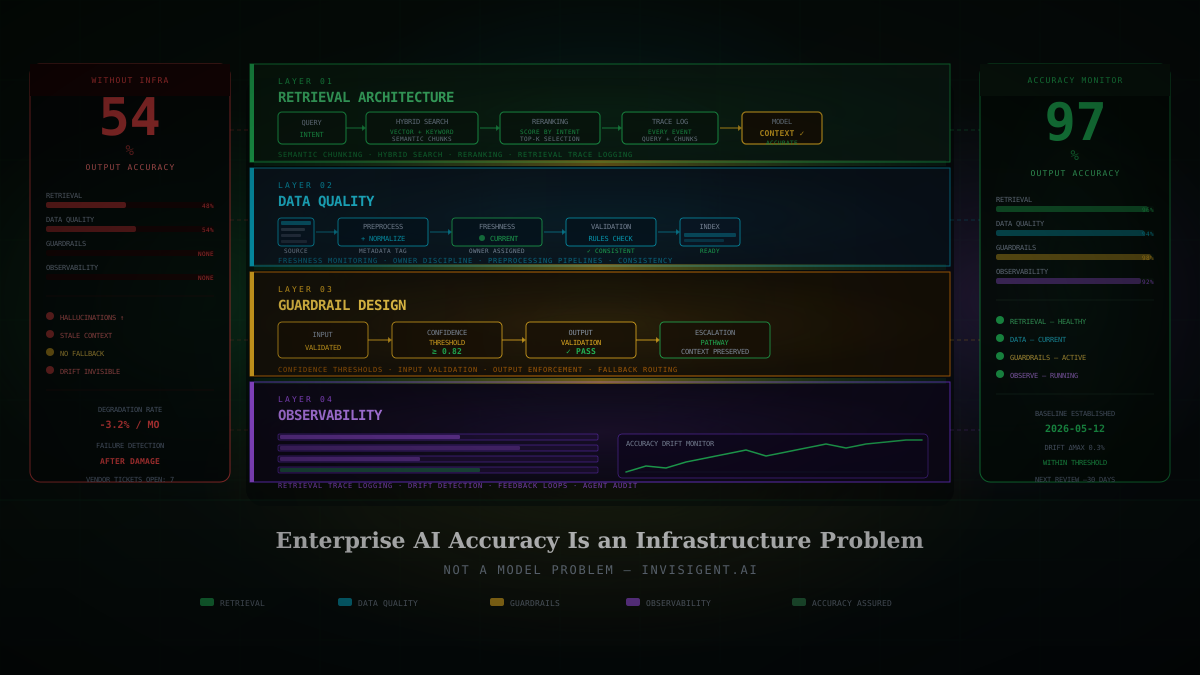
Why Enterprise AI Accuracy Is an Infrastructure Problem Not a Model Problem
Most organizations debugging AI accuracy problems are looking in the wrong place.
The Assumption That Sends Every Debugging Effort in the Wrong Direction
When an enterprise AI system produces inaccurate outputs wrong answers, hallucinated facts, misclassified requests, incorrect retrievals the instinctive response follows a predictable sequence.
The prompt gets adjusted. The model gets evaluated against alternatives. The vendor gets a support ticket. A more expensive model tier gets approved. The outputs improve slightly, then regress. The cycle repeats.
Months pass. Budget is spent. The accuracy problem remains structurally unsolved because every intervention targeted the model and the model was never the primary variable.
Enterprise AI accuracy is determined by the infrastructure underneath the model. The retrieval architecture that decides what context the model has access to. The data quality that determines whether that context is accurate and current. The guardrail design that contains incorrect outputs before they reach users or downstream systems. The observability infrastructure that determines whether the organization can even detect when accuracy has degraded.
Organizations that build these four layers correctly produce AI systems whose accuracy improves over time. Organizations that skip them produce AI systems whose accuracy is unknowable, unimprovable, and eventually abandoned.
The Four Layers That Actually Determine Enterprise AI Output Accuracy
Why Most Enterprise AI Implementations Skip These Layers
Most AI implementations are scoped as delivery projects with a defined completion point. Architecture is designed to get the system to launch. The launch date is the success metric. Post-launch performance is assumed to be the responsibility of the team that received the handover.
This project framing is fundamentally incompatible with production AI infrastructure. Production AI systems are operational assets, not delivered projects. They require the same ongoing governance, monitoring, and iteration discipline as any other critical operational infrastructure.
The layers described above retrieval architecture, data quality, guardrail design, and observability are not features that can be added after launch. They are architectural decisions that must be made before development begins. Retrofitting them into a system built without them typically costs more than building them correctly from the start.
What Production AI Accuracy Infrastructure Looks Like
A production AI system built with all four layers operating correctly looks structurally different from one built without them.
Documents are chunked at semantic boundaries. Hybrid search combines vector similarity with keyword precision. A reranking layer scores retrieved context against query intent before it reaches the model. Every retrieval event is logged with full trace data.
Knowledge bases have defined owners. Update processes are documented and followed. Data freshness is monitored. Preprocessing pipelines normalize documents before indexing. Metadata tagging enables filtered retrieval that surfaces the right sources for the right query types.
Confidence thresholds are defined and tested against representative query distributions. Fallback behaviors are documented and validated. Output validation runs before delivery. Escalation pathways preserve full context and route to the right human reviewer.
Accuracy baselines are established at deployment. Drift detection runs continuously. Agent decisions are logged and replayable. Feedback signals from the operational environment are captured and reviewed on a defined cadence.
This is the infrastructure that makes enterprise AI accuracy a manageable operational variable rather than an unknowable one.
The Compliance Dimension of AI Output Accuracy
For organizations operating in regulated industries or across jurisdictions with AI governance requirements, output accuracy is not only an operational concern. It is a compliance obligation.
High-risk AI systems are subject to accuracy, robustness, and transparency requirements. Organizations deploying AI in high-risk categories must demonstrate that accuracy has been assessed, monitored, and maintained. Observability infrastructure is a regulatory requirement, not optional.
AI systems that process personal data and produce outputs that affect individuals are subject to accuracy obligations under Article 5. Inaccurate outputs that affect data subjects create compliance exposure. Demonstrating accuracy monitoring is a material consideration.
The Digital Personal Data Protection Act establishes obligations around the accuracy of personal data processed by data fiduciaries. AI systems processing Indian personal data inherit these accuracy obligations and require monitoring architecture demonstrable on audit.
Frequently Asked Questions
Our AI system was accurate at launch and has degraded over time. What is most likely causing this?
The most common cause of accuracy degradation over time is data staleness combined with query distribution shift. The knowledge base that was accurate at indexing has not been updated as operational reality has changed. Simultaneously the queries the system receives have evolved as users have learned how to interact with it and edge cases that were rare at launch are now more frequent. An accuracy audit that examines retrieval trace logs against current query distributions will typically identify both patterns quickly. The fix is usually a combination of knowledge base refresh and retrieval architecture adjustment rather than model replacement.
We are an Indian mid-market organization. How does the DPDP Act affect our AI accuracy obligations?
India's Digital Personal Data Protection Act 2023 establishes accuracy as a principle for personal data processing. If your AI system processes personal data of Indian residents and produces outputs based on that data recommendations, classifications, responses, routing decisions the accuracy of those outputs is subject to DPDP obligations. Practically this means you need monitoring infrastructure that can demonstrate outputs based on personal data are accurate and that inaccurate outputs are detected and corrected. Every system we build for Indian organizations includes this infrastructure as standard.
We operate across India and the EU. Does accuracy infrastructure need to be different for each jurisdiction?
The underlying accuracy infrastructure retrieval architecture, data quality, guardrails, observability is the same across jurisdictions. What differs is the compliance documentation and the specific thresholds that trigger escalation or human review. EU AI Act high-risk requirements and GDPR accuracy obligations have specific documentation requirements that DPDP does not have in the same form, and vice versa. We design the accuracy infrastructure once and configure the compliance layer per jurisdiction so one system meets both frameworks without architectural duplication.
How do we establish accuracy baselines if we have never measured AI output accuracy before?
Start with a representative sample of queries drawn from your actual operational environment not test queries designed to produce correct outputs. Run those queries through the system. Have subject matter experts evaluate the outputs against ground truth. Document the accuracy rate per query category. This becomes your baseline. From deployment forward, automated monitoring compares current accuracy rates against those baselines and flags statistical deviation. The specific baseline number matters less than the discipline of measuring against a consistent reference point from the beginning.
Is it possible to add these accuracy infrastructure layers to a system that was already built without them?
Yes but the cost and complexity depend significantly on which layers are missing and how deeply the existing architecture would need to change to accommodate them. Missing observability infrastructure is typically the most straightforward to add. Missing guardrail design can usually be implemented at the orchestration layer without rebuilding the underlying system. Missing retrieval architecture improvements hybrid search, reranking, semantic chunking typically require rebuilding the retrieval pipeline, which is a significant but contained intervention. Poor data quality requires the most fundamental remediation because it affects every layer above it. An architecture audit conducted before any remediation work begins is the fastest way to determine what is actually missing and what the correct sequence of fixes should be.
Building AI Infrastructure That Is Accurate by Design
Accuracy Built In. Measured. Maintained.
Every engagement begins with a structured architecture review that assesses all four accuracy layers before development begins. Invisigent works with a limited number of organizations each quarter every engagement handled directly at the senior level.
Book Your Architecture Review →