How Production AI Teams Prevent Hallucinations, Control Costs, and Debug AI Systems With Observability
AI observability is not extra tooling bolted onto a finished product. It is the difference between guessing why your AI failed and knowing.
Building an AI feature is easy. Operating one is hard.
Over the last two years, thousands of companies have launched AI powered products: customer support assistants, internal copilots, sales agents, knowledge search, document processing, code assistants. For most teams, the first demo goes shockingly well. The model answers correctly, the workflow feels fast, and stakeholders walk away impressed.
Then the application reaches production, and a few weeks later the questions start. Why are responses suddenly slower? Why did AI costs double this month? Why is one customer getting better answers than another? Which prompt caused yesterday's quality drop? Why did the agent fail halfway through its workflow?
Infrastructure dashboards usually have nothing to say about any of this. Servers are healthy, databases are responding, the API isn't throwing errors. From an infrastructure standpoint, everything looks fine. But users are having a completely different experience.
This is the gap that AI observability exists to close.
Traditional monitoring stops where AI problems begin
Tools like Grafana, Datadog, and Prometheus are still essential. They tell you whether your application is running. AI observability tells you whether your AI is actually working, and that's a different question entirely.
Say a customer asks your assistant, "Can I upgrade my subscription?" Behind that one message, your application might search a vector database, retrieve documentation, build a prompt, call an LLM, execute billing APIs, validate the response, and finally return an answer. Traditional monitoring logs one successful request. AI observability records every decision along the way: which documents got retrieved, which prompt version ran, which model generated the answer, token usage, latency, tool calls, cost, and the evaluation score.
The difference shows up in the question you're able to ask afterward. Instead of asking whether the request succeeded, you get to ask why it behaved the way it did.
Why AI systems fail differently
Traditional software tends to fail loudly. Servers crash, requests time out, databases disconnect. AI systems rarely stop working overnight. Instead they get quietly worse: retrieval quality drifts down, a prompt update introduces a subtle regression, a model's behavior shifts, token usage creeps up, and costs climb without anyone noticing. Customers lose trust in the product well before any infrastructure monitor picks up on a problem.
That's the reason a lot of engineering leaders now treat AI observability as core production infrastructure rather than a nice-to-have debugging tool.
What every production team should be able to answer
Regardless of platform, a production AI system should be able to answer six questions.
Can we trace every request?
When a customer reports a bad response, your team should be able to reconstruct the whole workflow, not just the final answer, from retrieval through prompt construction through tool execution.
Do we know where the money is going?
AI costs get hard to manage fast without visibility. Good platforms break spend down by customer, feature, model, team, and environment, which makes optimization far more tractable than staring at a monthly cloud invoice.
Can we measure response quality?
A fast answer isn't the same as a good one. Track groundedness, hallucination rate, task completion, user feedback, and evaluation scores. Quality needs to be a production metric, not something checked on occasionally.
Can we debug AI agents?
Most modern AI systems aren't a single LLM call. They involve retrieval, planning, tool execution, memory, and external APIs. Observability should make each of those steps visible on its own.
Can we compare prompts and models?
Prompt engineering never really stops, and neither does model selection. Your platform should let you compare prompt versions, model versions, cost, latency, and quality without manually digging through logs.
Can the platform grow with us?
This isn't just about today's project. It's about whether it will still hold up as your architecture gets more sophisticated.
Comparing the leading platforms
The first question most teams ask is which platform to use. The honest answer: it depends less on the platform and more on the architecture underneath it. Most observability tools are solving the same core problem, helping you understand what happened during a request, but they differ in where they focus. Picking the right one starts with knowing what you actually need visibility into.
| Platform | Best suited for | Why teams choose it |
|---|---|---|
| Langfuse | Production AI products | Strong tracing, prompt management, evaluations, self-hosting, OpenTelemetry support |
| LangSmith | LangChain ecosystems | Excellent visibility into agent workflows and LangGraph applications |
| Phoenix | RAG-heavy applications | Deep insight into retrieval quality and grounding performance |
| Braintrust | Evaluation-first teams | Powerful automated testing and model benchmarking |
| Helicone | Rapid implementation | Proxy-based setup with immediate cost and latency visibility |
Rather than chasing a single "best" platform, pick the one that matches your architecture and priorities.
Our take
If you're building a production AI application today, we'd start with Langfuse in most cases. Not because it's universally the best, but because it balances flexibility, self-hosting, prompt management, evaluations, and OpenTelemetry compatibility better than most alternatives. If your stack leans heavily on LangChain, LangSmith is a natural fit. If retrieval quality is your main worry, Phoenix has specialized capabilities that are hard to match elsewhere.
Which platform you install matters less than making observability part of your engineering process from day one. Teams that wait until problems show up in production usually find that retrofitting observability afterward is a lot harder than designing for it up front.
Building an AI observability architecture that scales
Picking a platform matters. Designing the architecture around it matters more. We've seen teams spend weeks integrating an observability tool, only to discover months later they still can't answer basic production questions. Why did this response take 14 seconds? Which prompt version caused the regression? Why did token costs jump 40% last week? Which tool call made the agent fail? Why are enterprise customers seeing different answers than free users?
The problem was never the platform. It was that observability got treated as a logging exercise instead of an engineering discipline. A good architecture should surface every stage of an AI workflow, from the moment a request arrives to the moment a response goes out.
Think beyond the model
One of the more common misconceptions in AI engineering is that the model is where everything happens. In practice it's often just one piece in a much bigger workflow. A typical AI application might include user authentication, intent classification, retrieval from a vector database, prompt construction, multiple LLM calls, tool execution, external APIs, business logic, response validation, and evaluation pipelines. If you're only watching the LLM call, you're missing most of the system. Observability needs to cover the whole workflow, not just the model.
A reference architecture for production AI systems
Every organization's setup looks a little different, but most production AI systems follow roughly this pattern:
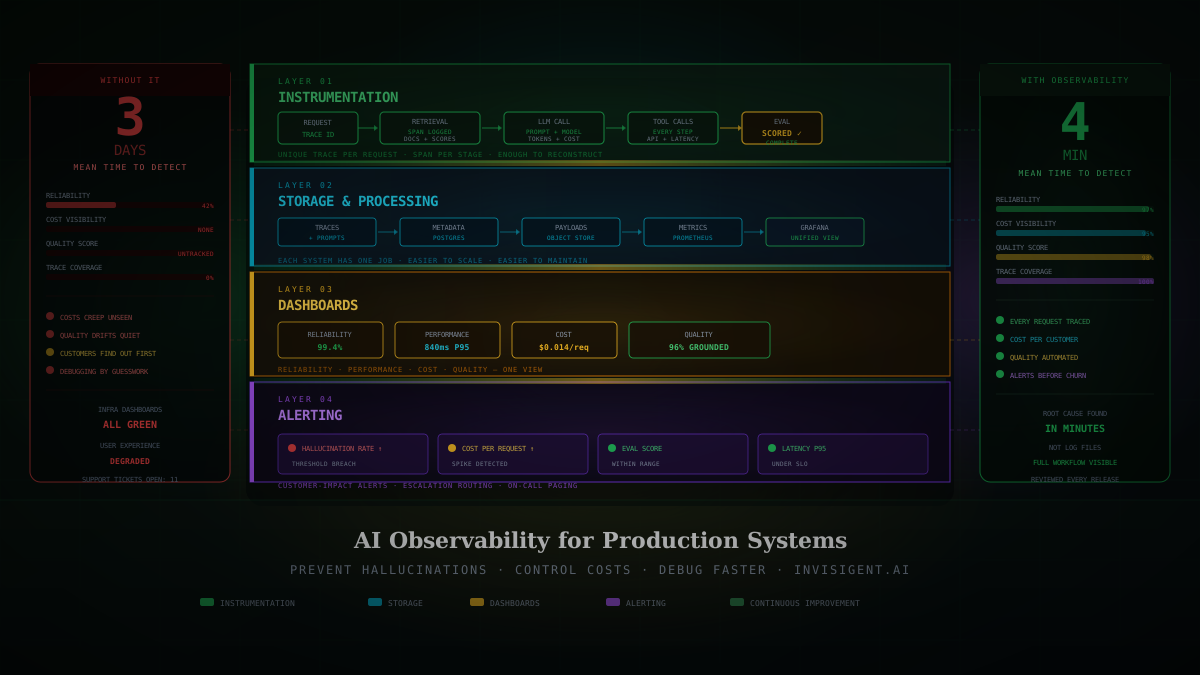
Every stage in that chain should generate telemetry. That telemetry is what debugging, optimization, and ongoing improvement actually run on.
The four layers of AI observability
Instead of one dashboard, think of observability as four connected layers.
Implementing AI observability
Once the architecture is in place, rolling it out gets a lot simpler. Rather than instrumenting everything at once, do it in stages.
Design for continuous improvement
The strongest AI teams don't reach for observability only when something's on fire. They use it every day, comparing prompt versions, reviewing evaluation trends, watching costs, measuring business outcomes, refining workflows. Over time, observability stops being a debugging tool and becomes the feedback loop the whole system runs on.
Five mistakes that limit AI reliability
The same patterns show up again and again as teams move from prototype to production. Avoiding them won't guarantee success, but it will cut down significantly on time spent diagnosing issues later.
Monitoring infrastructure instead of AI
Plenty of organizations already have mature application monitoring. They know when a server is overloaded or a database is slow. Customers still say the AI is getting worse, because infrastructure monitoring measures whether systems are up, while AI observability measures whether they are producing useful outcomes.
Treating the model as the entire product
When a response is bad, the model gets blamed first. Usually it is just one step in a longer chain, and the real issue is outdated retrieval data, poor prompt construction, a slow external API, a failed tool call, or missing context. Observability shows you where problems actually start.
Measuring speed instead of success
Fast responses make a good first impression. Accurate ones build trust that lasts. Track task completion, groundedness, user satisfaction, safety, evaluation scores, and escalation rates. They paint a much clearer picture of business value than response time alone.
Ignoring cost until finance notices
AI costs rarely spike overnight, they creep. Prompts get bigger, retrieval returns more documents, agent workflows grow more elaborate. Monitoring cost by request, feature, customer, and model turns optimization into routine engineering work instead of a fire drill.
Assuming production quality is permanent
One good deployment does not guarantee the next one holds up. Models evolve, knowledge bases change, expectations rise. Continuous evaluation is what catches a quality regression before customers do.
A production example
Say your company launches an AI customer support assistant. During testing, responses average three seconds and feedback is good. A month later, response times creep up to ten seconds and support starts reporting inconsistent answers. Traditional monitoring shows healthy servers, stable databases, no infrastructure alerts. Everything looks fine.
The trace tells a different story. A recent deployment bumped the number of retrieved documents from five to twenty five. That extra context inflated prompt size, which increased both latency and token usage, and the additional irrelevant information actually made responses worse, not better. Nothing was technically broken, the workflow had just become inefficient. Because every stage of the pipeline was visible, engineers found the root cause in minutes instead of hours of log diving.
That's the real value of observability: it shortens the distance between spotting a problem and fixing it.
Building an engineering culture around observability
Technology alone doesn't make AI systems reliable, engineering practices matter just as much. A few habits show up consistently among teams that ship dependable AI products.
Version everything
Prompts, models, evaluation datasets, retrieval pipelines, agent workflows. If it can change, version it. That is what makes regressions easy to spot and roll back.
Measure business outcomes
Infrastructure metrics tell you how the system performs. Business metrics tell you whether it is creating value: task completion, customer satisfaction, support ticket reduction, revenue influenced, cost per successful interaction.
Standardize observability across projects
Define shared standards for trace structure, metadata, prompt naming, evaluation datasets, and alert thresholds. It cuts operational complexity and makes it easier for teams to share what they learn.
Build observability into development, not after launch
Instrument workflows while they are still being built, so engineers can inspect traces as easily as they would check application logs. The earlier a problem is visible, the cheaper it is to fix.
Review AI systems regularly
Schedule regular reviews of cost trends, prompt performance, evaluation scores, retrieval quality, agent reliability, and user feedback. These reviews tend to surface optimization opportunities before customers notice a dip.
When you don't need a full observability platform
Not every AI project needs enterprise-grade observability. If you're experimenting with prompts, validating an idea, or building a small internal prototype, structured logging is probably enough. But as complexity grows, so does the need for visibility. Once your application includes retrieval, multiple models, tool calling, autonomous agents, or real customers, observability stops being optional.
A simple production readiness checklist
Before launching an AI application, ask yourself:
Can we trace every request from start to finish?
Do we know exactly how much each interaction costs?
Are prompts and models version-controlled?
Can we compare model and prompt performance over time?
Are quality evaluations running automatically?
Can engineers explain why a specific response was generated?
Are alerts configured for quality, cost, and latency regressions?
Can we identify failures without relying on customer reports?
If several of these are hard to answer, strengthening your observability setup should be near the top of your engineering priorities.
Final thoughts
As AI becomes core to modern software, reliability is what will separate the products that last from the ones that don't. A more capable model can improve performance. Better prompts can improve responses. Neither one solves the operational problems that show up once an application hits production.
The organizations getting lasting value out of AI are investing in something broader: systems they can actually observe, understand, and improve. That's what observability gives you. It turns AI from a pile of prompts and models into an engineering system you can measure, optimize, and trust over time, and for teams building production AI, that visibility isn't optional anymore. It's part of the architecture.
Some teams are already handing part of that watch to agents themselves. Anthropic, for example, assigns dedicated Claude "Superfan" instances to read telemetry and logs for each component of its new source control system — see our breakdown of Anthropic Scion. And if your model traffic runs through an LLM gateway, that gateway is one of the richest sources of traces you have; our guide to proxies for AI agents covers how that layer works.
Frequently Asked Questions
What is AI observability?
AI observability is the practice of monitoring, tracing, and evaluating AI systems throughout their entire lifecycle. It provides visibility into prompts, model responses, retrieval pipelines, agent workflows, token usage, latency, costs, and response quality. Unlike traditional application monitoring, it helps engineering teams understand not just whether a request succeeded, but why it behaved the way it did.
Why is AI observability important?
Production AI systems are significantly more complex than traditional software applications. A single user request may involve multiple LLM calls, vector databases, external APIs, tool execution, and business logic. Without observability, it is difficult to diagnose rising AI costs, hallucinations, poor retrieval quality, slow responses, agent failures, or prompt regressions before they impact customers.
How is AI observability different from traditional application monitoring?
Traditional monitoring platforms focus on infrastructure health: CPU usage, memory consumption, request latency, server errors. AI observability extends beyond infrastructure by monitoring AI-specific signals, including prompt versions, model versions, token usage, retrieval quality, tool execution, agent reasoning, evaluation scores, and cost per request.
What metrics should I monitor in a production AI system?
A combination of technical, operational, and business metrics: response latency (P50, P95, P99), token usage, cost per request and per customer, prompt versions, model versions, retrieval relevance, hallucination rate, groundedness, task completion rate, tool success rate, user feedback, and evaluation scores. Focusing only on latency or uptime gives an incomplete view of system performance.
What is LLM observability?
LLM observability focuses specifically on monitoring interactions with large language models: prompts, responses, latency, token consumption, costs, and model performance. When applications include retrieval, memory, external tools, or autonomous agents, teams typically expand to broader AI observability practices that cover the entire workflow.
What is AI agent observability?
AI agent observability provides visibility into autonomous workflows where agents make decisions, call tools, retrieve information, and complete multi-step tasks. Rather than monitoring a single model response, it tracks the entire execution process, making it far easier to debug complex agent behavior and optimize workflow performance.
What is RAG observability?
RAG (Retrieval-Augmented Generation) observability focuses on monitoring the retrieval pipeline that supplies context to language models. It helps teams answer whether the correct documents were retrieved, whether the retrieved context was relevant, whether poor retrieval reduced answer quality, and which retrieval step caused increased latency.
Which AI observability platform should I choose?
It depends on your architecture and requirements. Langfuse suits production AI applications needing tracing, evaluations, and self-hosting. LangSmith works well for LangChain and LangGraph ecosystems. Phoenix is a strong choice for retrieval-heavy RAG systems. Braintrust specializes in evaluation pipelines and benchmarking. Helicone offers a lightweight proxy approach for monitoring usage and costs.
When should I implement AI observability?
Ideally before your AI application reaches production. It becomes especially important once your application serves real customers, uses RAG, includes AI agents, executes tool calls, has multiple prompts or models, or generates meaningful infrastructure costs. Adding it early makes future debugging, optimization, and scaling significantly easier.
Can AI observability reduce infrastructure costs?
Yes. By monitoring token consumption, prompt size, retrieval behavior, and model usage, observability helps teams identify unnecessary costs. Many organizations reduce AI spending by optimizing prompts, reducing unnecessary context, choosing more cost-effective models, improving retrieval quality, and eliminating redundant model calls.
Do small AI projects need observability?
Not always. For prototypes, hackathons, or internal experiments, structured logging is usually sufficient. As applications become customer-facing or business-critical, observability becomes increasingly important for maintaining reliability, controlling costs, and supporting ongoing improvements.
What are the biggest mistakes teams make when implementing AI observability?
Logging only the final model response, ignoring prompt versioning, monitoring latency but not quality, failing to measure AI costs, not collecting business metadata, skipping automated evaluations, and waiting until production issues appear before adding observability. Addressing these early helps teams build more reliable AI systems from the start.
Can OpenTelemetry be used for AI observability?
Yes. Many modern AI observability platforms support OpenTelemetry, allowing organizations to combine traditional application telemetry with AI-specific traces. This creates a unified view of infrastructure health and AI workflow performance, making production debugging and root cause analysis much more efficient.
What does a production AI observability dashboard typically include?
A comprehensive dashboard usually combines operational, financial, and quality metrics in one place: request traces, response latency, token usage, cost analytics, prompt history, model comparisons, evaluation results, retrieval quality, agent execution timelines, error rates, and alerts and incident history.
Build AI Systems You Can Operate With Confidence
What makes an AI product succeed was never the model it runs on.
At Invisigent, we help startups and growing businesses move past AI prototypes into production-ready systems that hold up. Whether you're building AI agents, RAG, internal copilots, or intelligent automation, the focus stays the same: reliable, measurable, and scalable from day one.
Talk to Us About Your AI Architecture →