
AI Infrastructure for Businesses in 2026
It is no longer about buying cloud credits or plugging in a new tool.
AI infrastructure has quietly become one of the most important conversations happening inside serious companies right now. It is no longer about buying cloud credits or plugging in a new tool. It is about building the actual foundation — the data systems, the compute, the workflows, the security — that lets AI do real work without falling apart under pressure.
From Experiments to Operations
For most companies, the shift happened faster than expected. What started as pilots and proofs-of-concept is now expected to run in production. And production is where the gaps show up: messy data, underpowered systems, cloud setups that were not designed for inference at scale, teams that know how to prompt a model but not how to govern one.
The question in 2026 is not whether your business should use AI. It is whether your infrastructure can actually support it.
AI infrastructure is the difference between an AI demo and an AI operation.
What It Really Means
AI infrastructure is the combination of everything underneath the model — the data pipelines feeding it, the compute running it, the storage holding it, the security protecting it, and the workflows connecting it to the rest of the business. Strip any one of those away and you get systems that are slow, brittle, or expensive to maintain.
The Six Layers That Matter
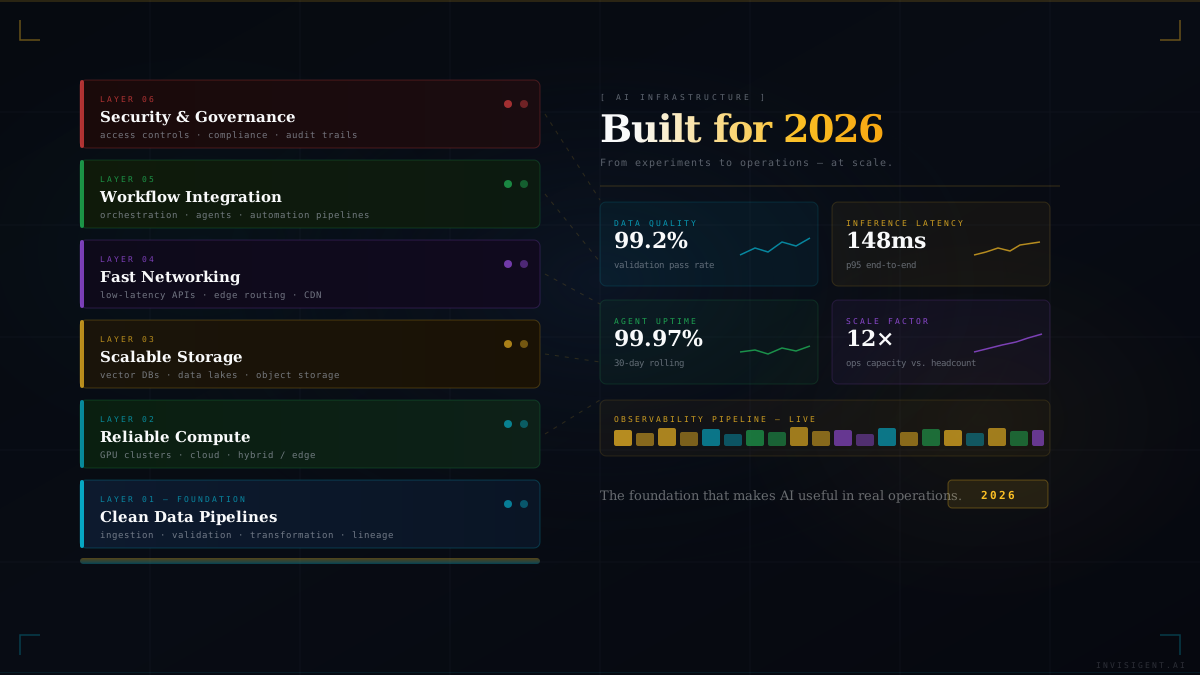
Most companies that are doing this well have built across six core areas. Each one matters independently. Together, they are what allows AI workloads — which are more data-hungry and compute-intensive than normal software — to run without creating operational chaos.
Clean Data
The hardest truth about AI is that it reflects the quality of the data behind it. If your business data is scattered across a dozen tools, inconsistently formatted, or never validated, the AI built on top of it will behave accordingly. Centralizing data, defining clear formats, and maintaining validation determines whether everything else is worth building.
Reliable Compute
Cloud is still where most companies start — and for good reason. It makes GPUs accessible, allows fast experimentation, and removes upfront hardware cost. But cloud alone is not always the right answer. For workloads that demand low latency, handle sensitive data, or need to sit close to where the work happens, a hybrid or edge setup often makes more sense. The right choice depends on your specific workload, not on what is currently fashionable.
Scalable Storage
Vector databases, data lakes, object storage — AI workloads generate and consume data at a volume that conventional storage architectures were not designed for. Scalable storage that is organized around retrieval speed and data lineage is foundational to every layer above it.
Fast Networking
AI inference is latency-sensitive. A model that produces an answer in 150ms can become a bottleneck that stalls a workflow if the networking layer introduces hundreds of milliseconds of additional delay. Low-latency API routing, edge delivery, and efficient data transfer between compute and storage layers are infrastructure decisions that directly affect AI performance in production.
Workflow Integration
AI does not run in isolation. It connects to CRMs, document systems, communication platforms, and business processes. Workflow integration — the orchestration layer that routes data between AI systems and the rest of the business — determines whether AI actually reduces friction or adds it. This is where most implementations struggle.
Governance
As AI systems touch more internal and customer data, security stops being a technical afterthought and becomes a business requirement. That means access controls, secure storage, compliance-aware data handling, and clear policies for what AI is and is not allowed to do. Governance also matters for practical reasons: AI should support human decisions, not replace accountability.
Agents Need Real Infrastructure
AI agents have moved from research projects to business tools, and that transition comes with real operational requirements. An agent that sends emails, updates your CRM, or generates reports is not just a feature — it is a system that needs logging, permission controls, fallback logic, and human oversight when something goes wrong.
Treating agents like production software instead of impressive demos is the mindset shift most companies have not fully made yet.
Scaling Is About Simplification, Not Addition
The instinct when AI is not performing is to add more: more compute, more tools, more models. But the companies that scale AI successfully tend to do the opposite first. They consolidate systems, remove redundant processes, and build repeatable workflows before they expand.
There are also real physical constraints — power, cooling, data center capacity — that matter more at scale than most technology leaders expect.
What a Good Architecture Actually Looks Like
The most effective setups in 2026 are layered: structured data sources, orchestration tools connecting everything, scalable compute, APIs or agent runtimes on top, observability running throughout, and security built in from the start.
That kind of system does not happen by accident. It requires every layer of the infrastructure to be stable and designed to hold up under real usage.
Who This Applies To
This matters most for companies that have moved past experimentation — SaaS businesses, service firms, agencies, and enterprises trying to turn AI pilots into reliable operations. It especially matters for anyone building AI assistants, internal copilots, workflow automation, or customer-facing agents.
And it matters for the leaders who are tired of seeing AI investments underdeliver because the foundation was not built before the features were.
The businesses that win in 2026 will not be the ones that use the most AI tools. They will be the ones that build the strongest infrastructure around data, compute, security, and operational design.
Frequently Asked Questions
What is AI infrastructure in simple terms?
AI infrastructure is the set of systems that let AI run inside a business, including data, compute, storage, security, and workflow automation. It is the foundation that makes AI useful in real operations.
Why do businesses need AI infrastructure in 2026?
Businesses need it because AI workloads are now more complex, more production-focused, and more dependent on clean data, scalable systems, and secure deployment. Without the right setup, AI tools become slow, unreliable, or expensive.
Do small businesses need AI infrastructure too?
Yes, but the setup can be lighter. A small business may only need structured data, cloud-based tools, automation workflows, and basic governance rather than a large enterprise stack.
What is the biggest mistake companies make with AI?
The biggest mistake is automating broken processes. AI cannot fix unclear workflows, poor data, or disorganized operations, so businesses should build systems first and automate second.
Should companies use cloud or on-premise AI?
Many start in cloud because it is faster and easier to scale, but some move toward hybrid or edge setups when latency, cost, or data control becomes important. The best choice depends on the workload and business requirements.
How do AI agents fit into infrastructure?
AI agents sit on top of infrastructure and need access to data, tools, APIs, and runtime controls to work safely. They are not standalone features — they depend on the whole system underneath them.
Ready to Build the Right Foundation
Infrastructure First. AI That Actually Works.
Invisigent works with a limited number of organizations each quarter to design and implement AI infrastructure that holds up under real production conditions. Every engagement is handled directly at the senior level.
Book Your Infrastructure Review →