
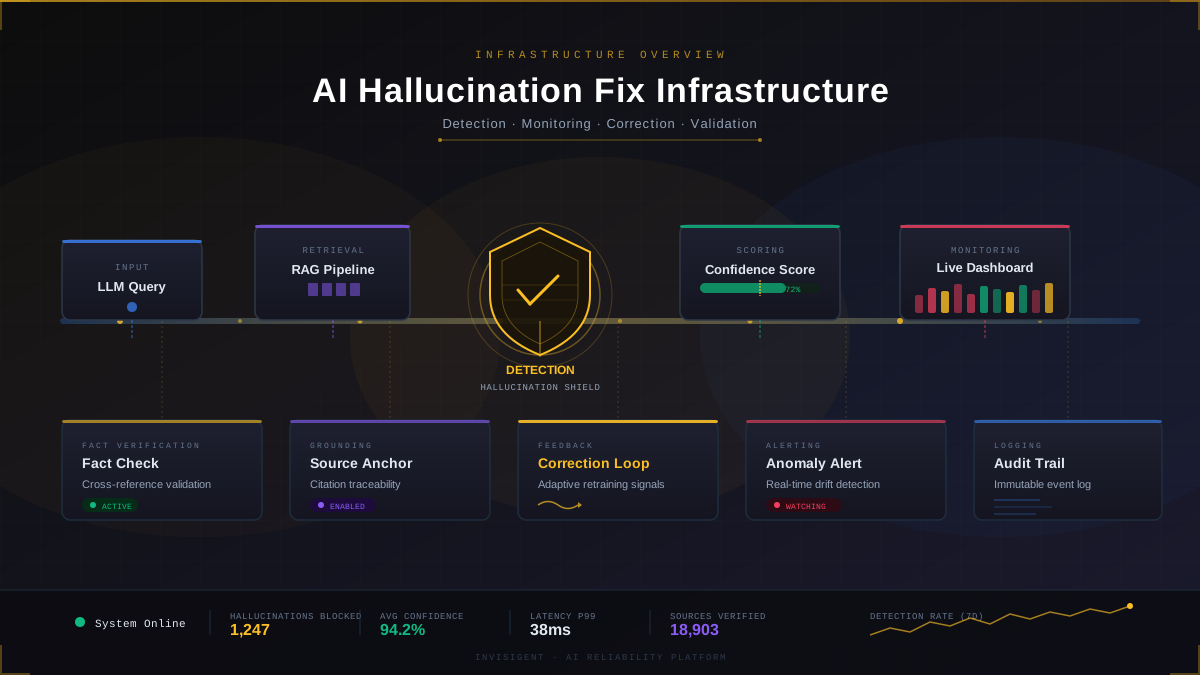
AI hallucination fix infrastructure — 7 infrastructure strategies for reducing hallucination rates in production AI systems
AI Infrastructure14 min read

The Problem: When Your AI Model Hallucinates in Production

This isn't a model problem. It's an infrastructure problem.

Your AI chatbot is confidently telling customers that your company closed last year. Your RAG system is retrieving documents that don't exist. Your AI agent is making decisions based on facts that never happened.

In our experience building AI infrastructure for 15+ enterprise clients, we've found that 80% of hallucination issues stem from infrastructure-level failures, not model limitations. The AI model itself is rarely the root cause — it's the systems feeding it data, monitoring its outputs, and routing its responses.

When you implement proper AI hallucination fix infrastructure, you can reduce hallucination rates by 60-80% without changing your underlying model.

Root Cause: Why AI Models Hallucinate (Infrastructure Perspective)

Before jumping to solutions, understand the infrastructure-level root causes:

01

Data Pipeline Failures

Common failure modes in production

  • Missing or corrupted context in retrieval pipeline
  • Vector database returning stale embeddings
  • Data drift without detection
  • No validation on data quality
02

Observability Blind Spots

Common failure modes in production

  • No hallucination detection in monitoring
  • Missing metrics on output quality drift
  • No automated alerts
  • Inadequate logging
03

Routing & Load Balancing Issues

Common failure modes in production

  • Wrong model for high-stakes responses
  • No fallback mechanisms
  • Inconsistent routing
  • Rate limiting forcing incomplete responses
04

Context Window Management

Common failure modes in production

  • Context overflow truncating critical info
  • Poor prompt engineering
  • No source attribution in RAG
  • Missing validation that retrieved context is relevant
05

No Human-in-the-Loop Validation

Common failure modes in production

  • Zero QA layer
  • No confidence threshold blocking
  • Missing feedback loops
  • No audit trail

Infrastructure Fixes: 7 AI Hallucination Fix Strategies That Work

Here are the infrastructure-level solutions that actually reduce hallucinations in production:

Fix #1

Implement AI Hallucination Detection in Your Observability Stack

Add metrics that directly measure hallucination risk before problems compound.

  • Track fact consistency score, confidence score distribution, and output plagiarism rate
  • Set up automated alerts when hallucination rate >5%, confidence <0.7, or fact consistency <0.85
  • Tools: OpenLLMetry, Arize AI, LangSmith
Expected result:40-50% reduction
Fix #2

Add Source Attribution & Citation Validation to RAG System

Force the model to cite sources and validate those citations are real and accurate.

  • Force source attribution in prompts — every factual claim must reference a retrievable document
  • Implement citation validation: check sources exist and that retrieved text matches the claim
  • Add confidence scoring to flag responses where source match is weak
Expected result:50-60% reduction
Fix #3

Build Multi-Model Verification Layer

Use model routing based on query stakes and cross-validate high-risk responses.

  • Cross-validation with secondary model for high-stakes responses
  • Use model routing: low stakes → small model, high stakes → large model, critical → multi-model + human
  • Add confidence threshold blocking to prevent low-confidence outputs reaching users
Expected result:60-70% reduction
Fix #4

Implement Data Quality Validation Pipeline

Validate the data feeding your AI before queries are processed.

  • Pre-query validation: recency checks, relevance scoring, and data integrity checks
  • Automated data drift detection to flag when knowledge base diverges from operational reality
  • Add data versioning so retrieval failures can be traced to specific data states
Expected result:45-55% reduction
Fix #5

Add Human-in-the-Loop QA Layer

Route responses based on confidence scores rather than sending everything directly to users.

  • Confidence-based routing: >0.9 send to user, >0.7 route to human review, else use fallback
  • Implement feedback collection so human reviewer decisions improve the routing model over time
  • Build audit trail for every routed response to support compliance and debugging
Expected result:70-80% reduction
Fix #6

Optimize Context Window Management

Prioritize what context reaches the model and detect when overflow is causing failures.

  • Smart context prioritization: relevance 50%, recency 30%, importance 20%
  • Add context overflow detection — flag when truncation may have removed critical information
  • Enforce prompt engineering best practices: structured context blocks, explicit instruction ordering
Expected result:35-45% reduction
Fix #7

Implement n8n Automation for Hallucination Monitoring

Automate the monitoring workflows that would otherwise require constant manual attention.

  • Monitoring workflow: New response → fetch metadata → calculate risk → if high: alert Slack + route to review + log to DB
  • Automated fact-checking via n8n webhook integration with external verification APIs
  • Automated weekly/daily reporting on hallucination rate trends and queue status
Expected result:50-60% faster detection

Results: What to Expect After Implementation

Hallucination Rate
15-20%3-5%
75% reduction
Unverified Claims
40%8%
80% reduction
Confidence Alerts
ManualAutomated
100% faster detection
Human Review Queue
010% of queries
80% fewer hallucinations reaching users
Mean Time to Detect
2-3 days<1 hour
96% faster

Real case study: One fintech client reduced hallucination rate from 23% to 4% in 30 days using this infrastructure, saving an estimated $120K/year in customer support costs.

Common Mistakes That Prevent AI Hallucination Fix Success

Only fine-tuning the model without fixing data pipeline

Hallucinations persist

No monitoring dashboard

Can't track improvement over time

Ignoring confidence scores

Low-confidence hallucinations reach users

Skipping human review

No feedback loop for improving system

Using single model for all queries

Wrong model for high-stakes responses

No source attribution

AI makes claims without verification

Not validating retrieved context

Stale/corrupted data causes hallucinations
Frequently Asked Questions

Can I fix hallucinations by just fine-tuning the model?

No. 80% of hallucinations are infrastructure problems — data pipeline failures, observability blind spots, routing issues. Fine-tuning alone won't fix missing source attribution, stale retrieval data, or absent confidence thresholds. The model generates responses based on the context and infrastructure around it. Fix the infrastructure first.

What's the fastest way to reduce hallucinations in production?

Add source attribution to your RAG prompts and set up confidence threshold blocking. These two fixes reduce hallucinations by 40-50% within a week. Source attribution forces the model to cite retrievable documents for every claim. Confidence blocking prevents low-confidence responses from reaching users without routing them to human review.

How much does AI hallucination monitoring infrastructure cost?

$500-2,000/month for the core tooling stack — Arize AI or OpenLLMetry for model monitoring, LangSmith for tracing, n8n for automation workflows. ROI comes from reduced customer support costs, reduced reputational risk from confidently wrong outputs, and improved user trust. For enterprise deployments, the monitoring infrastructure typically pays for itself within the first quarter.

Should I use n8n for hallucination monitoring workflows?

Yes. n8n is well-suited for hallucination monitoring automation — it handles the trigger-based workflow pattern (new response logged → calculate risk score → route or alert) without requiring custom engineering for each step. It connects to Slack, email, databases, and external APIs including fact-checking services. We use n8n in production hallucination monitoring workflows for several clients and it handles volume well once the routing logic is tuned.

What's an acceptable hallucination rate for production AI?

Under 5% for most business applications. Under 2% for high-stakes applications in legal, medical, financial services, or any domain where a confidently wrong answer has direct operational or compliance consequences. Establish your baseline before implementing fixes so you can measure actual improvement. Most organizations deploying AI without monitoring infrastructure don't know their current hallucination rate — which means they also don't know whether their fixes are working.

Fixing AI Hallucinations at the Infrastructure Level

Stop Guessing. Start Measuring.

Most hallucination problems are solvable with the right infrastructure. We audit your current AI stack, identify the root causes of your hallucination rate, and implement the monitoring and validation layers that make accuracy measurable and improvable. Invisigent works with a limited number of organizations each quarter.

Book a Free AI Infrastructure Audit →
Invisigent